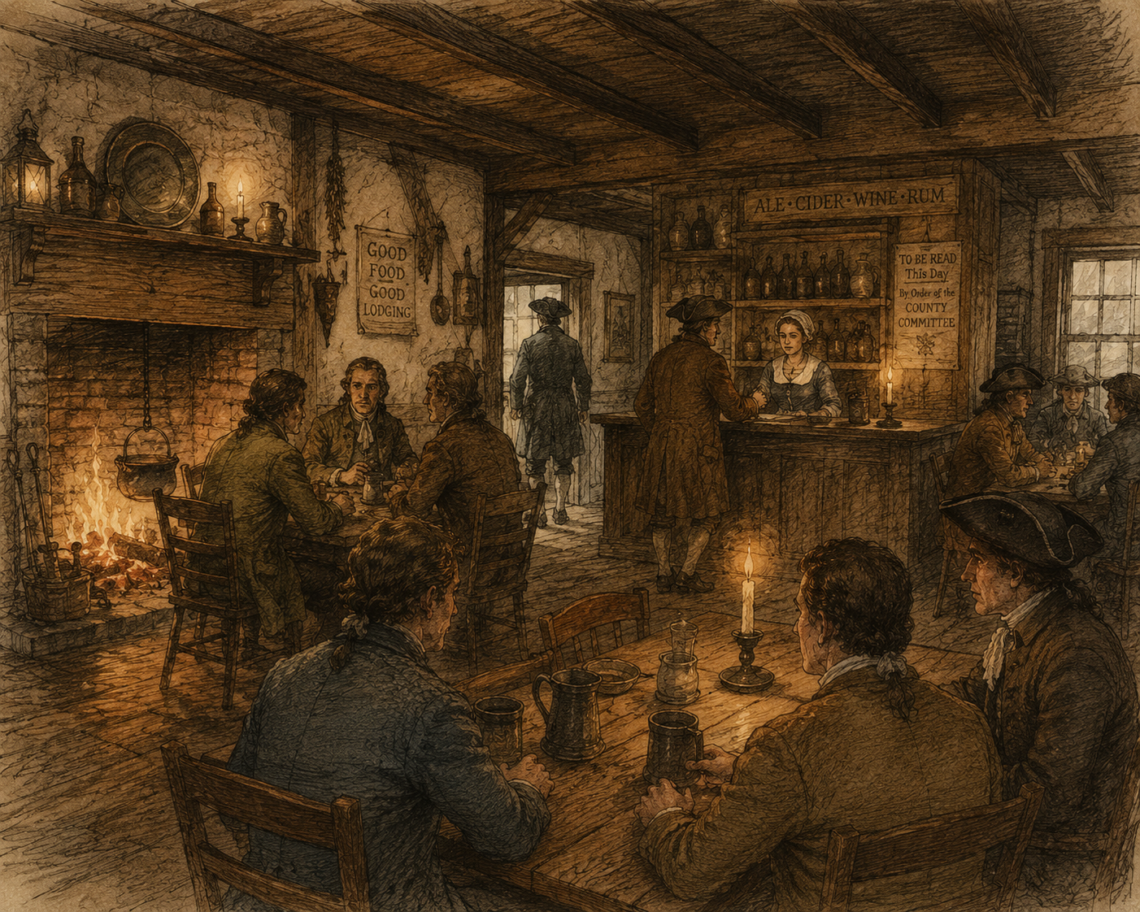
The Colonial Tavern: The Living Room of Early Virginia
Today, when we think of a tavern, we often imagine a place to order a meal or enjoy a drink with friends. In colonial Virginia, however, a tavern was something far more important. It was the community’s dining room, hotel, courthouse waiting room, post office, stagecoach stop, news center, business office, and social gathering place—all under one roof.
Long before railroads, telephones, and newspapers connected communities, taverns connected people.
More Than a Place to Drink
Travel in eighteenth-century Virginia was slow and often difficult. Roads were little more than dirt paths winding through forests and across streams. A traveler might spend an entire day covering twenty or thirty miles before reaching a safe place to spend the night.
The tavern became an essential destination.
Merchants conducted business there. Lawyers met with clients. Surveyors compared notes. Farmers sold livestock. Politicians campaigned. Militia officers gathered. Ministers occasionally preached. Elections were announced, contracts negotiated, and local gossip exchanged over shared meals.
As tensions with Great Britain grew during the years before the American Revolution, taverns assumed an even greater role. They became places where newspapers were read aloud, letters were shared, and travelers brought news from Williamsburg, Philadelphia, Boston, and beyond. Around tavern tables, ordinary citizens debated taxation, Parliament’s latest actions, and the rights of the colonies. Local committees met, militia companies organized, and neighbors discussed whether resistance was justified. Although the great speeches of independence were delivered elsewhere, many of the conversations that prepared Virginians for revolution began in taverns, where ideas traveled as readily as the stagecoaches that carried the news.
Even the courts recognized their importance. County justices licensed tavern keepers, inspected their facilities, and regulated the prices they could charge for meals, lodging, and drink. Taverns were considered a public necessity rather than merely private businesses. They were among the few places where travelers and local residents from every walk of life could gather, making them indispensable to the social, economic, and political fabric of colonial Virginia.
The Tavern Keeper
Running a tavern demanded far more than hospitality.
The tavern keeper was cook, innkeeper, stable manager, bartender, merchant, accountant, mediator, and often community leader. He—or quite frequently she—was responsible for providing clean beds, wholesome food, dependable horses or stable space, and a welcoming hearth.
Many taverns were family operations. While the proprietor greeted guests, wives and daughters prepared meals, baked bread, churned butter, tended gardens, brewed beverages, and oversaw the many daily chores necessary to feed travelers.
Their success depended largely upon reputation. Word spread quickly about establishments known for good food, comfortable beds, or honest dealing.
A Meal Worth the Journey
Unlike today’s restaurants, colonial taverns rarely offered menus.
Travelers generally ate whatever had been prepared that day from ingredients produced on the farm or purchased from nearby neighbors. Seasonal availability dictated nearly everything served.
A typical meal might include roasted chicken, smoked ham, beef stew, rabbit, venison, or salt pork accompanied by baked beans, cabbage, turnips, squash, onions, carrots, or greens gathered from the kitchen garden.
Fresh bread appeared at nearly every meal. Butter, often made only hours earlier, accompanied coarse loaves of wheat, rye, or corn bread. Cheese, pickles, preserves, and apple butter rounded out the table.
During autumn, apples, pears, walnuts, and chestnuts became common fare. In summer, berries and peaches found their way into pies and simple desserts.
Cooking relied almost entirely upon open hearths, cast iron kettles, Dutch ovens, cranes, spits, and bake ovens. Meals required constant attention from cooks who judged heat not by thermometer but by experience.
Something to Drink
Contrary to popular imagination, not everyone spent the day drinking whiskey.
Small beer, cider, and ale were everyday beverages because water was not always dependable, particularly in towns. Rum punch, Madeira wine, imported port, and locally distilled spirits were available for those who wished to indulge.
Virginia’s gentlemen often preferred Madeira, which tolerated long ocean voyages better than many European wines. Thomas Jefferson famously hoped Virginia would someday become a great wine-producing region, though European grape varieties struggled in the colony’s climate.
One wonders what Jefferson might think if he could sit today beneath the Virginia sky enjoying a glass of locally produced Chambourcin or Cabernet Franc.
A Night’s Lodging
After supper, travelers climbed narrow staircases to modest sleeping chambers.
Privacy was uncommon. Several unrelated guests often shared a room, and sometimes even a bed if accommodations were crowded. Mattresses might be stuffed with straw, corn husks, feathers, or rope supports. Blankets were wool, windows drafty, and fireplaces struggled against winter cold.
Yet after a long day on horseback, most travelers considered these conditions luxurious compared to sleeping outdoors.
Below, horses occupied nearby stables where they received fresh hay, oats, and water before continuing the next day’s journey.
News Traveled by Conversation
Perhaps the tavern’s greatest contribution was not food or lodging but communication.
Before newspapers reached every community, news traveled by people.
Travelers carried stories from Williamsburg, Alexandria, Winchester, Baltimore, Philadelphia, and beyond. They reported crop failures, market prices, military movements, legislative debates, and political arguments.
A man might arrive carrying yesterday’s newspaper from Richmond. Before evening, its contents had become everyone’s conversation.
Ideas that eventually shaped the American Revolution spread through precisely these kinds of informal conversations around tavern tables.
Ordinary Places That Shaped Extraordinary Times
Colonial taverns rarely appear prominently in history books, yet they quietly influenced nearly every aspect of early American life.
They supported commerce by providing lodging for merchants. They encouraged settlement by making travel possible. They fostered community by bringing strangers and neighbors together around shared tables. They carried information across great distances before modern communication existed.
Perhaps most importantly, they reminded people that even difficult journeys became easier when shared with others over a warm meal and a welcoming fire.
Echoes Around Today’s Table
Although nearly 250 years have passed, something of the colonial tavern survives whenever friends gather over food, stories, and a glass of wine.
We no longer arrive on horseback or carry letters tucked inside saddlebags. We no longer warm ourselves before an open hearth after traveling muddy Virginia roads.
Yet the desire remains remarkably unchanged.
We still seek places where conversation lingers long after the meal has ended, where strangers become acquaintances, and where stories are exchanged as freely as food and drink.
Perhaps that is the tavern’s greatest legacy—not merely the buildings themselves, but the enduring idea that hospitality is measured not only by what is served on the table, but by the fellowship shared around it.
