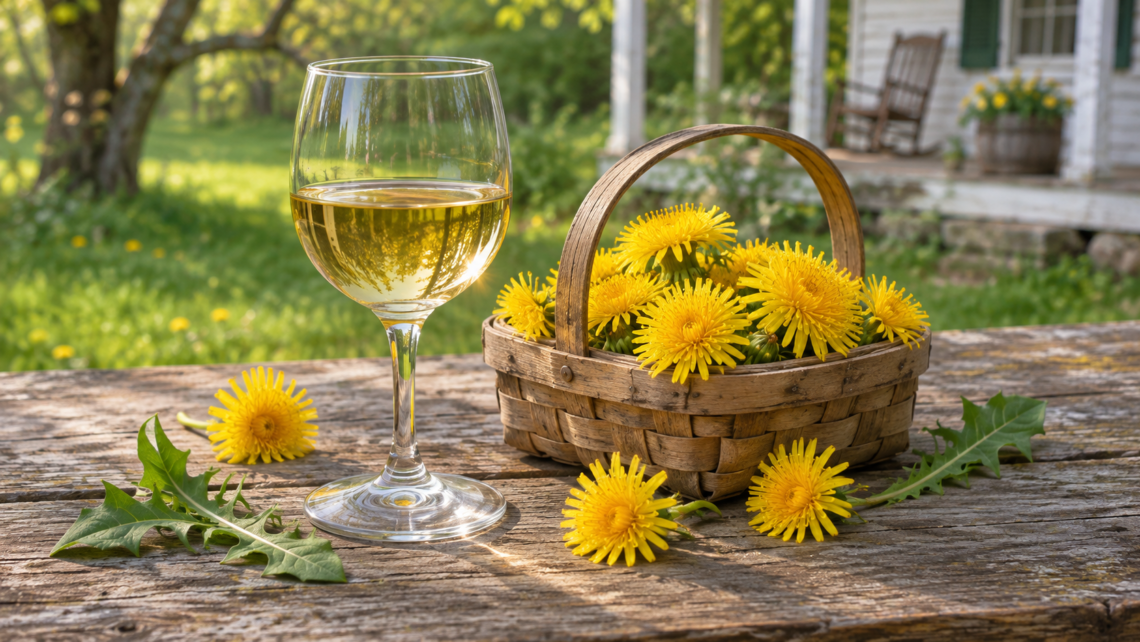
Dandelion Wine
The drink the refused to be a weed
Over the years, more people than we can count have come into the tasting room at Hiddencroft and asked us, “Do you make dandelion wine?” Some wanted to know if we’d ever tasted it. Others had a story to tell about someone they knew who gathered dandelions or made wine from the blossoms. Those conversations stayed with us, and they’re the reason for this series. We’ll talk about what dandelion wine is and why people make it, when and where to gather the flowers, and how to turn a basket of yellow blossoms into a batch of wine.
Part I: Before It Was a Beverage, It Was a Problem
There are plants that people cultivate with intention—grapes, apples, barley—and then there are plants that arrive uninvited and refuse to leave.
The dandelion belongs firmly in the second category.
Long before anyone thought to ferment it, the dandelion was already embedded in human life. It followed us across continents, tucked into the margins of fields, gardens, and footpaths. The name itself comes from the French dent de lion—lion’s tooth—a reference to the jagged edges of its leaves. It is not a flattering name, but it is accurate.
The plant is stubborn. It grows where it is not wanted and thrives where more delicate things fail. It pushes through gravel, clay, and neglect with equal determination. If a vineyard vine behaved like a dandelion, growers would call it miraculous.
Instead, we call it a weed.
But that classification says more about us than it does about the plant.
Because for most of human history, the dandelion was not an intruder—it was a resource.
Part II: The First Fermentations (and the People Who Refused to Waste Anything)

5
No one can point to the exact moment dandelion wine was first made. That is usually the case with practical knowledge—it does not arrive as an invention so much as a realization.
At some point, someone looked at a yard full of yellow blossoms and thought: This is too much to ignore.
Dandelions were already valued in ancient Europe and Asia as medicinal plants. Their leaves were eaten as greens. Their roots were dried and used in tonics. They were, in every sense, useful.
Fermentation was simply the next logical step.
By the time of medieval Europe, home fermentation was common practice. People fermented whatever was available—berries, grains, apples, honey, and occasionally things that would not immediately suggest themselves as drinkable.
Dandelions fell into that category.
In colonial America, where resourcefulness was not a virtue but a requirement, dandelion wine became part of a broader tradition of “country wines.” These were wines made not from grapes, but from whatever the land offered freely.
And the land, in spring, offered dandelions in absurd abundance.
There is a quiet practicality in this. Grapes require planning, space, and patience. Dandelions require only a willingness to bend down and pick them.
Part III: The Taste of Something That Shouldn’t Work (But Does)
7
If you have never tasted dandelion wine, your first assumption is likely wrong.
It does not taste like dandelions.
It does not taste like grass, or bitterness, or anything you associate with the plant as it grows in your lawn. Instead, it is surprisingly delicate.
The best versions are light-bodied and golden, somewhere between a white wine and a memory of honey. There are notes that people struggle to describe—floral, yes, but not perfumed; slightly herbal, but not sharp; faintly sweet, even when fermented dry.
It is a wine that seems to carry sunlight in it.
That may sound like romantic exaggeration, but it is the only description that persists across generations of people who have made it.
The reason is simple: dandelion wine is made from the flower heads, not the leaves. The bitterness stays behind. What remains is something softer, almost improbable.
It is the transformation that makes it interesting.
A plant dismissed as a nuisance becomes something you would pour into a glass and offer to a guest.
Part IV: Health—Between Folklore and Fact
4
Dandelions have always carried a reputation for being “good for you.”
In traditional herbal medicine, they were used for digestion, liver support, and general “cleansing.” Teas made from the leaves and roots were common, and the plant was often described as a tonic for the whole system.
Modern science has taken a more measured view.
Research suggests that dandelion contains vitamins A, C, and K, along with minerals like potassium. Some compounds found in the plant show antioxidant and anti-inflammatory properties. There is also ongoing study into its effects on digestion and liver function.
But—and this is where folklore and fact part ways—fermentation changes things.
Dandelion wine is not the same as eating the plant or drinking a tea. Alcohol alters the chemical composition and reduces some of the original nutritional value. Whatever health benefits remain are modest at best.
Which leads to a slightly uncomfortable conclusion:
Dandelion wine is probably not a health tonic.
But it is also not entirely disconnected from the long tradition of using plants for nourishment and well-being.
If nothing else, it carries forward the idea that something overlooked can still have value.
And that may be the more durable benefit.
Part V: How to Make It (or, What to Do With a Yard Full of Yellow)

6
There is no single “correct” recipe for dandelion wine, which is both liberating and mildly frustrating.
But the general method has remained consistent for generations.
You will need:
- Fresh dandelion flower heads (a great many of them)
- Sugar
- Water
- Citrus (usually lemons or oranges)
- Yeast
- Optional: raisins or ginger for body and complexity
The process, in plain terms:
- Harvest the flowers
Pick them on a dry day, ideally when fully open. Avoid areas treated with chemicals. Remove as much of the green base as possible to reduce bitterness. - Make an infusion
Pour boiling water over the petals and let them steep for a day or two. This draws out the color and subtle flavor. - Build the must
Add sugar, citrus, and any additional ingredients. This becomes the base for fermentation. - Ferment
Add yeast and allow the mixture to ferment over several weeks. - Strain and age
Transfer to a secondary vessel and let it age for several months—longer if you have the patience. - Bottle and wait (again)
Like many wines, it improves with time. Which is unfortunate, because curiosity tends to peak early.
Part VI: Why It Endures

7
Dandelion wine persists for the same reason many old practices persist.
Not because it is efficient. Not because it is necessary.
But because it connects people to something older than convenience.
There is a moment, standing in a field of dandelions, where the modern instinct is to eliminate them. Spray them, mow them, restore order.
And then there is another instinct—quieter, less efficient—that asks a different question:
What if this is not a problem? What if this is an opportunity?
Dandelion wine lives in that second question.
It is not just a drink. It is a small act of reinterpretation.
A refusal to accept that something has no value simply because it arrived without permission.
And in that sense, it may be one of the more honest wines ever made.
