History of the Hiddencroft Property
A Small Piece of Virginia Land with an Extraordinary American Story
Today, visitors to Hiddencroft Vineyards see a quiet farm tucked into the countryside near Lovettsville, Virginia. There are vineyards, a pond, an old bank barn, a springhouse and smokehouse, and Dutchman’s Creek winding through the property.
But beneath that peaceful landscape lies a remarkable history.
Over more than two centuries, the land that became Hiddencroft has been connected with soldiers of the American Revolution, members of one of colonial Virginia’s most powerful families, farmers, millers, orchardists, enslaved laborers, craftsmen, and generations of ordinary families who shaped the land into the place we know today.
Some of the names connected with this property lead surprisingly far beyond Loudoun County—to George and Martha Washington, the Marquis de Lafayette, the Battle of Brandywine, the Continental Army, and the great Fairfax landholdings of colonial Virginia.
The history of Hiddencroft is therefore not simply the history of a house or a farm.
It is the story of many hands shaping one piece of land.
Before Hiddencroft: The Fairfax Proprietary
The story begins long before there was a vineyard—or even a United States.
The land lay within the vast Northern Neck Proprietary associated with the Fairfax family, whose holdings stretched across millions of acres of northern Virginia.
Through leases, inheritances and sales, portions of that enormous domain gradually passed into the hands of the German-speaking settlers who were establishing farms in the area that became known as the German Settlement and, eventually, Lovettsville.
Among those families were the Axlines.
Their arrival begins one of the most remarkable chapters in the history of this land.
John Axline: A Revolutionary Soldier and the Gunpowder Story
Johannes Oeschlein—later known as John Axline—came from a German immigrant family and settled in the Lovettsville area around 1770.
When the American Revolution began, Axline served in Posey’s Company of the 3rd Virginia Regiment.
But family records preserve another intriguing part of his wartime story.
Axline was reportedly involved in manufacturing gunpowder for the Continental Army. The tradition is supported by research undertaken by his grandson, General Henry A. Axline, who reportedly located military supply records concerning powder made by his grandfather.
Exactly where Axline manufactured the powder remains uncertain, and later historical research suggests it may have been produced in Pennsylvania rather than here in Loudoun County.
That distinction is important.
What remains significant is that a man whose family was intimately connected with this land participated directly in the struggle for American independence—not simply as a soldier, but apparently in supplying one of the Continental Army’s most essential commodities.
The quiet fields surrounding Hiddencroft were becoming connected to a much larger American story.
Lawrence Everhart: From Brandywine to the Hiddencroft Land
Another extraordinary Revolutionary figure soon became associated with the property.
Sergeant Lawrence Everhart served in the Continental Army and fought through some of the defining campaigns of the Revolution.
At the Battle of Brandywine on September 11, 1777, the young Marquis de Lafayette was wounded in the leg. Everhart is traditionally credited with helping carry the wounded Lafayette from the battlefield to safety.
Years later, Everhart’s life intersected directly with the land that would become Hiddencroft.
In 1791, Lawrence Everhart leased approximately 237 acres from Adam Axline. That property had previously been leased from the Fairfax family.
For many years historians believed that Everhart continued to live primarily in Maryland while others worked his Loudoun property. More recent research has strengthened the possibility that he actually lived here for several years during the 1790s.
Thus, for a brief period, a veteran of the Revolution—and a man remembered for helping save the wounded Lafayette at Brandywine—was farming land associated with the future Hiddencroft property.
In 1796, Everhart transferred his lease to David Axline.
The next chapter had begun.
Ferdinando Fairfax: A Direct Link to George Washington
Behind these leases stood another remarkable figure: Ferdinando Fairfax.
Fairfax belonged to one of the most prominent families in colonial Virginia. But his connection to the founding generation was considerably more personal.
When Ferdinando was baptized, George Washington and Martha Washington stood as two of his godparents.
The relationship continued throughout his life. Ferdinando visited Mount Vernon, corresponded with Washington and consulted him on business matters. When George Washington died in December 1799, Ferdinando Fairfax was among the principal mourners at his funeral.
Fairfax eventually controlled extensive lands inherited through his family.
And in 1801, Ferdinando Fairfax sold the land associated with our story to David Axline.
With that transaction, a piece of the old Fairfax proprietary passed into private ownership by the family that had already been farming it.
It is an extraordinary link in the property’s chain of title:
George and Martha Washington’s godson → David Axline → the later farms from which Hiddencroft would eventually emerge.
The Kalb Family and Pomona
The nineteenth century brought another family to the property—the Kalbs.
Their era transformed the landscape in ways that can still be seen today.
The Kalbs developed a mill along Dutchman’s Creek and established a nursery known as Pomona. The property became not simply a working farm but a deliberately cultivated landscape.
A mill pond supplied water for the mill. Trees were planted around the pond. A rustic gazebo stood among them. Nursery stock grew nearby, and the sound of moving water and machinery would have been part of everyday life.
Today the mill is gone.
The road has changed.
The old mill race has largely disappeared from view.
But the landscape still holds clues.
The pond remains. Old cypress trees still stand near its banks. Stonework survives at the mill site. Somewhere beneath grass, woods and later roads may lie portions of the old roadbed and watercourse that once served the mill.
The landscape itself has become an historical document.
The Compher Farm: Nearly a Century on the Land
In 1868, another long chapter began when Joseph Compher acquired the farm.
The Compher family would remain associated with this land for approximately a century.
The property passed through generations of the family, including John W. Compher and Charles Elbert Compher.
During those years the farm changed continually.
There were crops to plant, livestock to tend, fences to repair, wood to cut, fruit to harvest and buildings to maintain. Sheep grazed the fields. An orchard occupied part of the property. Farm buildings rose, disappeared, burned, were repaired or were replaced.
The surviving bank barn—rebuilt in 1929—belongs to this period, as do other elements of the farm landscape that remain recognizable today.
The Comphers did not simply own this land.
They shaped it.
From the Compher Farm to Hiddencroft
The Compher family’s century on the property ended in 1968.
The farm subsequently passed to Fred Hetzel, and in 1978 the larger property was divided into substantial rural parcels.
What had once been part of a much larger farm was gradually transformed into the collection of properties familiar today.
Hiddencroft eventually came to encompass approximately 26 acres of that historic landscape.
The vineyard was planted in 2001.
The tasting room opened in 2008.
And another layer was added to a story that had already been unfolding for more than two centuries.
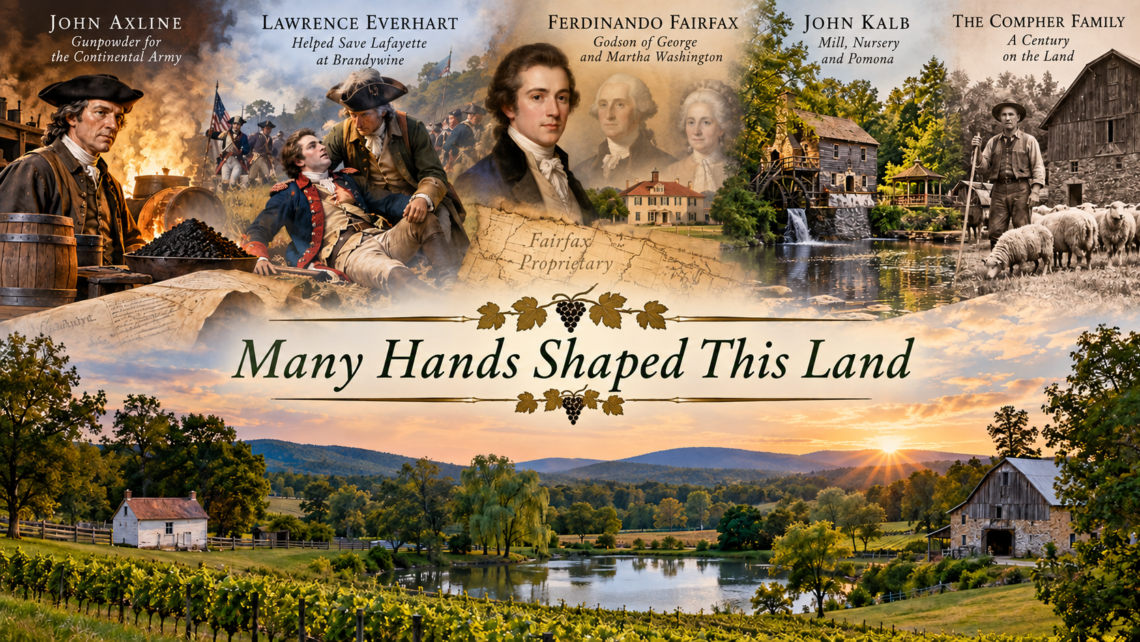
Many Hands Shaped This Land
It is tempting to tell the history of an old property simply by listing its owners.
But that would miss much of the story.
The history of Hiddencroft is about relationships between people and land.
A Revolutionary soldier associated with supplying gunpowder to the Continental Army.
A veteran traditionally remembered for helping carry the wounded Marquis de Lafayette from the battlefield at Brandywine.
The godson of George and Martha Washington.
German-American farming families establishing themselves in the Loudoun Valley.
Millers harnessing Dutchman’s Creek.
Nurserymen planting trees.
Farm families raising sheep, cattle and crops.
And generations of people whose names may never appear in history books but whose labor left marks that can still be found across the property.
Some of those marks are obvious—the barn, springhouse, smokehouse and pond.
Others are subtler: a line of old trees, stones beside a creek, the remains of a foundation, an abandoned roadbed, or the faint course of a mill race disappearing into the woods.
Together they tell a much larger story.
Many hands shaped this land.
And today, Hiddencroft is simply its newest chapter.