Chambourcin and the Luxury of Time
How an Experiment with the 2015 Vintage Shaped Our Approach to the 2016 Chambourcin Reserve
At Hiddencroft Vineyards, we have long been intrigued by a question that challenges conventional expectations about winemaking: What happens when a wine is given considerably more time in the barrel than tradition suggests it needs?
Our Chambourcin wines provided an opportunity to explore that question.
Chambourcin, a French-American hybrid grape, is widely appreciated for its deep color, expressive fruit character, and versatility. It is often made into wines intended for relatively early enjoyment, with an emphasis on freshness and approachability.
But we wondered whether Chambourcin might have another side—one that would emerge only after years of patient maturation.
The answer began with our 2015 vintage.
The 2015 Chambourcin: An Experiment in Time
Our 2015 Chambourcin spent its first four and a half years maturing in neutral oak barrels.
At that point, we evaluated the wine and made a decision that would eventually influence our approach to subsequent vintages.
We bottled a portion of the 2015 Chambourcin, while allowing the remainder to continue aging in barrel.
The first bottling represented the wine after four and a half years of élevage—already a considerable period of maturation for Chambourcin.
The remaining wine stayed in neutral oak for another three years, reaching a total of seven and a half years before bottling.
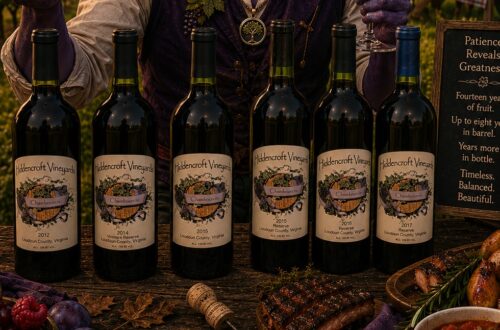
We designated this later bottling Chambourcin Reserve 2015.
The two bottlings gave us an unusual opportunity to explore how three additional years of barrel maturation could influence wines originating from the same harvest.
The experiment was not intended simply to produce an older wine. We wanted to understand whether additional time could encourage greater harmony among the wine’s fruit, tannins, acidity, and other structural elements.
What the Experiment Revealed
The extended maturation of the 2015 Chambourcin proved successful enough to influence our future winemaking decisions.
The results convinced us that Chambourcin could benefit from a much longer period in barrel than is commonly associated with the variety.
That was an important discovery for us.
Chambourcin is frequently described as a fruit-forward, approachable wine. Its reputation is not generally built on the expectation that it will spend seven or eight years maturing in oak.
Yet our experience with the 2015 vintage suggested that the grape had the potential to develop a different character when given sufficient time.
The experiment also reinforced a principle that has become central to our winemaking philosophy: the appropriate length of élevage should be determined by the wine’s development, not simply by customary aging periods.
The 2016 Chambourcin: Applying What We Learned
When it came time to determine the aging approach for our 2016 Chambourcin, we no longer needed to repeat the experiment.
The success of the 2015 vintage had already demonstrated what extended maturation might accomplish.
We therefore made a deliberate decision to allow the entire 2016 Chambourcin vintage to remain in neutral oak for seven and a half years.
There would be no intermediate bottling at four and a half years.
Instead, the wine would follow the longer maturation schedule that had proven successful with the 2015 Reserve.
After seven and a half years in barrel, the 2016 Chambourcin was bottled as Chambourcin Reserve 2016.
What began as an experiment with one vintage had become an intentional winemaking practice with the next.
Why Neutral Oak?
Both vintages underwent their extended maturation in neutral oak barrels.
Unlike new oak, which can contribute pronounced flavors such as vanilla, toast, and spice, neutral oak has already given up much of its extractable flavor during previous use.
This makes it particularly interesting for prolonged maturation.
The purpose is not to continually add oak flavor to the wine, but to provide an environment in which its existing components can evolve gradually.
During barrel aging, changes in tannins, aroma compounds, and other elements may influence a wine’s texture, balance, and complexity.
Neutral oak does not eliminate the effects of the barrel. Oxygen exposure, evaporation, and cellar conditions continue to influence the wine, making careful monitoring essential.
Nor does additional time automatically produce a better wine. Excessive aging can diminish fruit character or introduce unwanted oxidative qualities.
But when a wine responds favorably, extended élevage can reveal characteristics that might never emerge during a shorter maturation period.
What Seven and a Half Years Can Accomplish
Our 2016 Chambourcin Reserve offered another opportunity to observe the effects of unusually prolonged barrel aging.
During its earlier development, the wine displayed noticeable astringency and oak influence.
As the years passed, those characteristics gradually became less prominent. The wine developed a smoother texture, while its fruit character became more concentrated and expressive, particularly through the middle of the palate.
The resulting wine was markedly different from its younger self.
It had not simply grown older. Its balance and personality had changed.
This transformation was precisely the possibility that had inspired our original experiment with the 2015 vintage.
From Experiment to Philosophy
The story of our 2015 and 2016 Chambourcin Reserves illustrates how winemaking decisions can evolve through observation and experience.
In 2015, we divided a vintage into two bottlings, separated by three years of additional barrel maturation.
The success of that experiment led us to adopt the longer aging period for the entire 2016 vintage.
Both wines ultimately spent seven and a half years in neutral oak before being bottled as Reserves.
Neither was produced according to a conventional timetable for Chambourcin.
Instead, they reflected our willingness to question assumptions about the grape and explore what might happen when its development was allowed to continue well beyond the expected period.
At Hiddencroft, extended élevage is not about proving that every wine should spend more time in barrel.
It is about recognizing that some wines may have more to reveal—and being willing to give them the opportunity.
The 2015 Chambourcin taught us what might be possible.
The 2016 Chambourcin Reserve allowed us to put that lesson into practice.
And after seven and a half years of patience, observation, and anticipation, our conclusion remains wonderfully simple:
We are not disappointed.